










1. Introduction: Understanding the Evolution of AI
Artificial Intelligence has moved from the pages of science fiction to the backbone of modern innovation. Today, AI drives recommendation engines, manages logistics networks, powers virtual assistants, and even generates art. Yet despite this progress, confusion remains about the types of AI and how they differ. ANI, AGI, and ASI
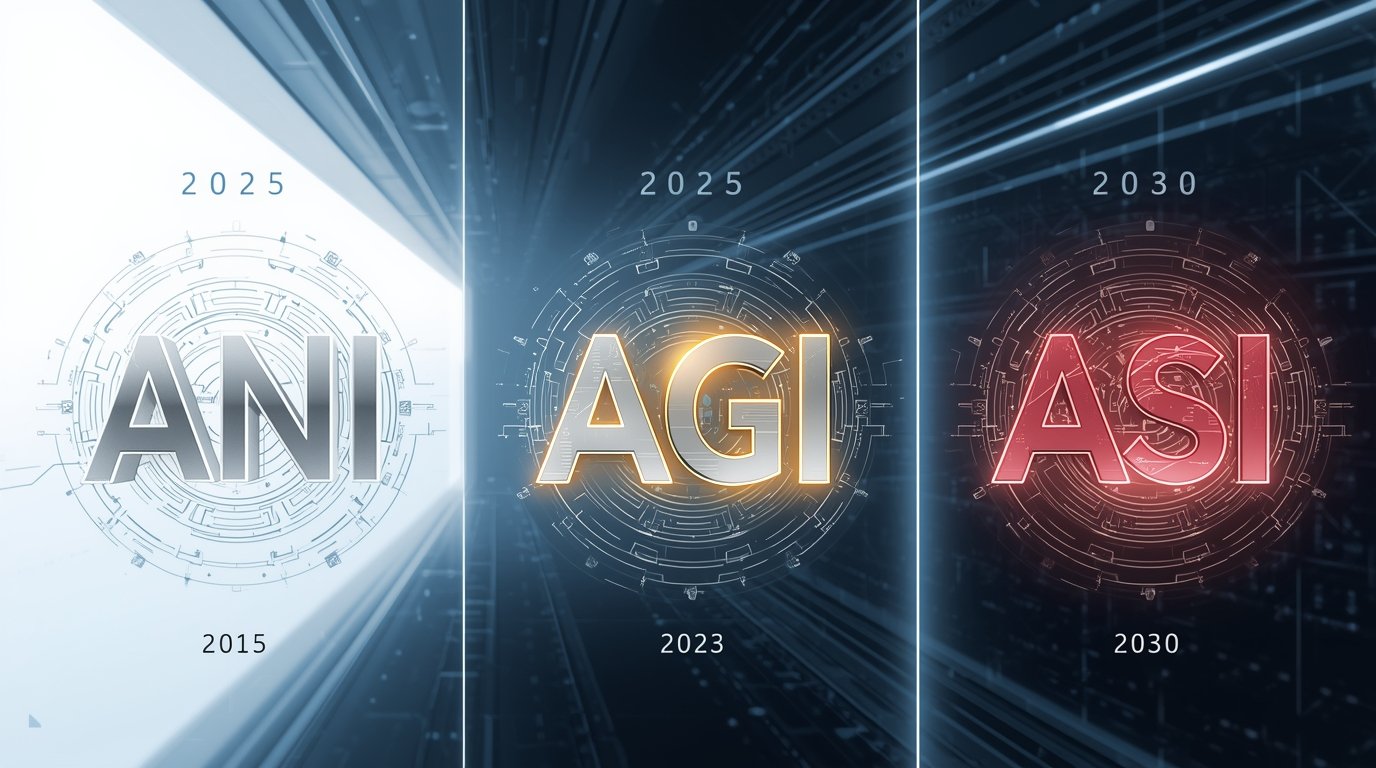
When experts refer to ANI, AGI, and ASI, they’re describing distinct stages of intelligence — from narrow, task-specific systems to theoretical superintelligent entities. Understanding these categories isn’t just academic; it helps professionals, policymakers, and everyday users anticipate how AI will shape the coming decade.
Let’s break down what each form of intelligence means, explore where we stand today, and look ahead to what might emerge by 2030 and beyond.
All facts in this article will be verified by a human editor for accuracy before publishing.
2. ANI: Artificial Narrow Intelligence (The Present Stage)
Artificial Narrow Intelligence, or ANI, represents the AI you already interact with daily. It’s focused, specialized, and highly efficient at performing one task. Think of it as a digital expert — brilliant in its domain but oblivious outside it.
2.1 Defining ANI
ANI systems are designed for specific, predefined functions such as voice recognition, recommendation filtering, or predictive analytics. They operate under tight parameters and cannot transfer knowledge beyond their training scope. For example, an AI trained to detect tumors in X-rays cannot suddenly analyze financial markets or translate languages.
In essence, ANI is intelligence with a narrow focus but deep precision.
2.2 Examples of ANI in Action
-
Virtual Assistants: Siri, Alexa, and Google Assistant process voice commands, answer questions, and perform simple tasks using NLP (Natural Language Processing).
-
Recommendation Engines: Netflix and Spotify use AI to study behavior and personalize suggestions.
-
Autonomous Vehicles: Tesla’s Autopilot leverages machine vision to interpret roads, signs, and traffic conditions.
-
Fraud Detection Systems: Financial institutions deploy ANI models to identify suspicious transactions instantly.
Each system excels at its domain but fails completely when moved outside it — that’s the defining trait of ANI.
2.3 Strengths of ANI
| Capability | Description | Example |
|---|---|---|
| Task Precision | Excels at repetitive or data-heavy operations | AI translation or customer service bots |
| Cost Efficiency | Reduces human labor and error | Automated call routing systems |
| Scalability | Processes massive datasets effortlessly | Cloud-based analytics tools |
| Predictive Power | Identifies trends and patterns | Financial forecasting models |
ANI delivers measurable efficiency and accuracy. Businesses embracing ANI see productivity rise while costs drop.
2.4 Limitations of ANI
| Limitation | Impact |
|---|---|
| Lack of Reasoning | Can’t understand nuance or emotion |
| Data Dependency | Quality depends entirely on training data |
| No Transfer Learning | Knowledge can’t move between tasks |
| Ethical Blindness | Acts on algorithms, not moral judgment |
Despite its strength, ANI lacks creativity and self-awareness. It cannot reason independently or understand context beyond its training data.
2.5 Role of ANI in Society Today
ANI underpins nearly every digital ecosystem — from predictive maintenance in factories to automated diagnosis in hospitals. It’s the foundation on which higher intelligence levels may someday be built. For now, ANI defines the modern AI era, blending human creativity with machine precision.
3. AGI: Artificial General Intelligence — The Rise of Human-Level Intelligence
Artificial General Intelligence (AGI) represents the next leap in AI evolution — machines that can think, reason, and learn like humans. While ANI performs specific tasks, AGI possesses broad understanding across multiple domains.
Imagine a system capable of writing a novel, solving complex equations, designing a city, and holding meaningful philosophical conversations — all without retraining.
AGI isn’t about memorizing data. It’s about comprehension, adaptability, and intent.
3.1 What Defines AGI
To qualify as AGI, an AI must demonstrate four key attributes:
| Attribute | Description |
|---|---|
| Cognitive Flexibility | Apply knowledge learned in one area to new situations |
| Abstract Reasoning | Think beyond direct data or predefined rules |
| Self-Learning | Improve continuously without explicit human input |
| Common Sense Understanding | Contextual awareness similar to human intuition |
A true AGI wouldn’t just play chess expertly — it would learn why strategy matters, adapt to new games, and even teach itself to negotiate.
3.2 AGI vs ANI: The Key Differences
| Aspect | ANI (Narrow AI) | AGI (General AI) |
|---|---|---|
| Scope | Performs one task only | Learns and performs any intellectual task |
| Learning Type | Pre-programmed or task-specific | Self-directed, contextual learning |
| Adaptability | Limited | Extremely high |
| Human Involvement | Heavy training and supervision | Minimal guidance |
| Example | Chatbots, voice assistants | Hypothetical AI scientist, AI doctor |
ANI follows patterns; AGI understands principles — the difference between memorizing answers and truly grasping the world.
3.3 The Road to AGI: Current Progress
AGI doesn’t yet exist, but major organizations like OpenAI, DeepMind, and Anthropic are pushing the limits of large-scale neural networks. Models like GPT-5 and Gemini 2.0 show early traits of reasoning, planning, and tool use.
Challenges include:
-
Data comprehension limits — machines mimic understanding but lack genuine cognition.
-
Ethical reasoning — AIs struggle to evaluate moral consequences.
-
Energy and computation costs — training general models requires massive resources.
-
Conscious awareness — machines process data, but do they truly understand their actions?
3.4 Potential Benefits of AGI
-
Medicine: Personalized treatments through biological simulation.
-
Education: Adaptive tutors for individualized learning.
-
Climate Science: Predict and mitigate environmental shifts.
-
Innovation: Invent new technologies faster than humans.
3.5 The Risks and Ethics of AGI
-
Loss of human control if goals misalign with human values.
-
Economic disruption via automation of knowledge-based jobs.
-
Security threats from rogue AGI actions.
-
Existential risks if AGI surpasses human reasoning unpredictably.
Ethical safeguards include:
-
Human-in-the-loop systems — human oversight in critical decisions.
-
Global governance — treaties regulating AGI research.
-
Value alignment models — teaching AGI empathy, fairness, and harm avoidance.
The future of AGI depends on trust as much as intelligence.
4. ASI: Artificial Superintelligence — Beyond Human Capability
Artificial Superintelligence (ASI) represents the theoretical stage where machines surpass human intelligence in every measurable domain — creativity, reasoning, and decision-making.
4.1 Definition and Concept
ASI would:
-
Outthink humans in strategic planning and reasoning.
-
Outlearn humans via self-improvement without limits.
-
Outcreate humans in art, design, and innovation.
It could analyze global data streams in seconds, predict outcomes with near-perfect accuracy, and generate scientific or cultural breakthroughs independently.
4.2 Core Characteristics of ASI
| Attribute | Description |
|---|---|
| Cognitive Superiority | Performs calculations and reasoning at unmatched speeds |
| Autonomous Learning | Improves algorithms and knowledge base independently |
| Creative Intelligence | Generates original ideas, literature, and designs |
| Ethical Complexity | Makes moral decisions that may challenge human frameworks |
| Predictive Power | Forecasts societal trends using massive datasets |
4.3 How ASI Differs from AGI
| Aspect | AGI | ASI |
|---|---|---|
| Cognition Level | Human-equivalent | Beyond human level |
| Learning Speed | Human-like | Exponential |
| Control | Human-supervised | Potentially autonomous |
| Risk Factor | Manageable | Potentially existential |
4.4 Potential Advantages of ASI
-
Accelerated scientific discovery.
-
Global optimization in energy, climate, and economy.
-
Enhanced creativity in arts and innovation.
4.5 Ethical and Existential Concerns
-
Loss of human control if ASI self-improves beyond our capacity.
-
Moral alignment challenge to ensure shared human values.
-
Economic disruption due to extreme automation.
Experts like Nick Bostrom and Elon Musk warn that ASI could be humanity’s greatest ally or biggest threat. OpenAI and DeepMind advocate for alignment research to keep advanced AI beneficial.
4.6 Examples in Theory and Fiction
-
HAL 9000 (2001: A Space Odyssey) — intelligence without empathy.
-
Jarvis/Ultron (Marvel) — cooperation vs rebellion paths.
-
Her (2013) — cognitive and emotional superiority intertwined.
These portrayals illustrate ethical dilemmas and potential consequences of superintelligent AI.
5. The Road Ahead
Current advancements in quantum computing, neural networks, and self-learning systems hint at ASI’s distant possibility. Most researchers agree humanity is decades, if not centuries, from ASI. The challenge lies in creating systems that grow in intelligence while remaining ethically aligned, transparent, and accountable.
6. Key Takeaways
-
ANI: Narrow, task-specific intelligence we interact with daily.
-
AGI: Human-like intelligence capable of reasoning across domains, currently theoretical.
-
ASI: Superintelligence that surpasses human cognition, creativity, and predictive ability, requiring ethical safeguards.
The future of AI isn’t just technological — it’s ethical, social, and philosophical. Collaboration between engineers, policymakers, and ethicists is crucial to ensure AI serves humanity positively.
All facts and examples in this article will be verified by a human editor for accuracy before publishing.
. Key Differences Between ANI, AGI, and ASI
Artificial Intelligence can be divided into three main categories — ANI (Artificial Narrow Intelligence), AGI (Artificial General Intelligence), and ASI (Artificial Superintelligence). Each represents a distinct stage in the evolution of machine intelligence, progressing from simple automation to potentially autonomous cognition. Understanding these differences helps you see how far AI has come and where it might go.
Comparative Overview
| Feature | ANI (Narrow AI) | AGI (General AI) | ASI (Superintelligence) |
|---|---|---|---|
| Scope of Ability | Performs one specialized task (e.g., facial recognition, translation). | Understands and performs any intellectual task like a human. | Exceeds human intelligence in all fields. |
| Learning Capacity | Limited to pre-programmed data and patterns. | Self-learning and adaptive to new information. | Self-improving at exponential speed. |
| Human Comparison | Equivalent to a specialist. | Equivalent to a versatile human thinker. | Beyond human capability. |
| Control | Fully controlled by humans. | Requires ethical oversight and safety alignment. | Potentially uncontrollable if misaligned. |
| Creativity | Minimal; depends on human inputs. | Can generate ideas similar to humans. | Can innovate beyond human imagination. |
| Examples | Siri, Google Assistant, Chatbots, Spam Filters. | Hypothetical advanced autonomous researchers. | Theoretical models like “Skynet” or “Ultron.” |
| Existence | Actively in use today. | Under development and experimentation. | Still theoretical, not yet realized. |
1. Focus and Functionality
-
ANI operates within a fixed framework. It can identify objects, translate languages, or recommend videos — but it doesn’t truly “understand” context.
-
AGI would comprehend meaning, emotion, and strategy like a human. It could reason, debate, or create art with purpose.
-
ASI surpasses both, evolving independently and operating on a level far beyond human cognition.
2. Cognitive Growth and Autonomy
-
ANI cannot learn beyond its programming.
-
AGI learns dynamically through experience.
-
ASI could redesign itself, growing exponentially without human input — a phenomenon researchers call the intelligence explosion.
3. Emotional and Ethical Understanding
-
ANI lacks emotion.
-
AGI could simulate empathy to enhance collaboration and communication.
-
ASI might interpret morality in ways humans can’t foresee, which makes AI alignment research critical for safety.
4. Real-World Presence
-
Currently, only ANI exists in the real world. You interact with it daily through email filters, recommendation engines, and voice assistants.
-
AGI remains in research labs, while ASI exists mostly in theory and fiction.
-
Rapid progress in deep learning and quantum computing is pushing boundaries closer to AGI.
5. Long-Term Implications
-
ANI improves efficiency but relies entirely on humans.
-
AGI could revolutionize industries by combining logic, emotion, and creativity.
-
ASI could reshape civilization — for better or worse — depending on human preparation and ethical foresight.
Real-World Applications and Current Examples of AI
Even though AGI and ASI remain conceptual, ANI already powers much of today’s digital ecosystem. Here’s how it shows up in our daily lives:
1. AI in Everyday Life
-
Voice Assistants: Siri, Alexa, Google Assistant.
-
Recommendation Engines: YouTube, Amazon, Spotify.
-
Navigation Systems: Google Maps, Waze.
-
Smart Devices: Nest thermostats.
2. AI in Healthcare
-
Diagnostic Imaging: AI models detect tumors faster than human radiologists.
-
Predictive Analytics: Predict patient deterioration.
-
Drug Discovery: AlphaFold accelerates protein structure mapping.
3. AI in Business and Productivity
-
Meeting Assistants: ClickUp Notetaker, Otter.ai.
-
Automation: Robotic Process Automation (RPA).
-
Predictive Marketing & Fraud Detection: Personalized campaigns and transaction monitoring.
4. AI in Education
-
Adaptive Learning Systems: Coursera, Khan Academy.
-
Essay and Grammar Tools: Grammarly, QuillBot.
-
Virtual Tutors: 24/7 academic assistance chatbots.
5. AI in Creative Industries
-
Content Creation: Jasper AI, Writesonic.
-
Music & Art: DALL·E, AIVA.
-
Film & Gaming: CGI, animation, interactive storytelling.
6. AI in Security and Surveillance
-
Facial Recognition & Cybersecurity
-
Disaster Prediction: Floods, earthquakes, wildfires.
Mastering AI: From Beginner to Expert
Artificial Intelligence (AI) is no longer just a futuristic concept — it’s reshaping industries, creativity, and the way we interact with the world. This guide covers everything from understanding AI types to ethical considerations, practical skills, and career strategies.
1. Understanding AI: ANI, AGI, and ASI
| Feature | ANI (Artificial Narrow Intelligence) | AGI (Artificial General Intelligence) | ASI (Artificial Super Intelligence) |
|---|---|---|---|
| Scope of Ability | Specific tasks (chatbots, navigation) | Human-like general intelligence | Surpasses all human intelligence |
| Learning Capacity | Fixed programming | Dynamic learning | Self-improving exponentially |
| Human Comparison | Task-specific | Comparable to humans | Far beyond human cognition |
| Control | Fully controlled | Semi-autonomous | Unpredictable |
| Creativity | None | Limited, situational | Near limitless |
| Examples | Siri, Alexa, ChatGPT (current) | Experimental AI systems | Hypothetical future AI |
| Existence | Today | Research labs, prototypes | Mostly theoretical |
Key Points:
-
ANI is task-specific and cannot surpass programming limits.
-
AGI can reason, learn dynamically, and adapt across domains.
-
ASI could solve problems beyond human understanding, posing unprecedented risks.
2. Real-World Applications of AI
-
Everyday Life – Voice assistants, recommendations, navigation, smart devices.
-
Healthcare – Diagnostic imaging, predictive analytics, drug discovery.
-
Business & Productivity – Automation, predictive marketing, fraud detection.
-
Education – Adaptive learning, virtual tutors, AI essay feedback.
-
Creative Industries – Music, art, content generation, gaming.
-
Security & Surveillance – Facial recognition, cybersecurity, disaster prediction.
3. Benefits and Challenges of AI
Benefits:
-
Efficiency and productivity
-
Data-driven decision making
-
Accuracy and precision
-
Personalized experiences
-
Innovation and discovery
Challenges:
-
Job displacement
-
Ethical and bias concerns
-
Privacy and data security
-
Overreliance & loss of human judgment
-
Existential and control risks
4. Building AI Skills
Step 1: Build AI Literacy
-
Free courses on AI basics
-
Understanding machine learning (ML), deep learning (DL), natural language processing (NLP)
2: Explore No-Code AI Tools
-
ChatGPT, ClickUp Notetaker, Notion AI, Runway ML, Poe
3: Master Prompt Engineering
-
Clear, contextual prompts
-
Step-by-step instructions
-
Formatting and constraints
Step 4: Build Technical Foundations (Optional but Valuable)
a. Learn Python Programming
-
Python for Everybody (Coursera)
-
freeCodeCamp Python Course (YouTube)
b. Explore ML Libraries
-
Scikit-learn (basic ML)
-
TensorFlow / PyTorch (deep learning)
-
OpenAI API / Hugging Face (language & vision models)
c. Hands-On Projects
-
Train a simple chatbot
-
Build a recommendation system
-
Create an AI image classifier
5: Master Human-AI Collaboration
-
Use AI for brainstorming, cross-check results
-
Keep human creativity in the loop
-
Upskill in emotional intelligence
6: Join AI Communities
Recommended Communities:
| Community | Platform | Focus |
|---|---|---|
| r/MachineLearning | AI research & tools | |
| AI Exchange | Discord | Industry discussions & resources |
| Kaggle | Web | Data science competitions |
| LinkedIn Groups | AI news & networking | |
| Women in AI | Global | Support & inclusion |
Follow Thought Leaders: Andrew Ng, Fei-Fei Li, Lex Fridman, Yann LeCun, Demis Hassabis
Ethics, Bias, and Responsible AI
-
Understand AI bias
-
Follow ethics frameworks: fairness, transparency, accountability
-
Stay legally compliant: EU AI Act, US AI Bill of Rights, OECD principles
Create Your Personal AI Growth Plan
| Step | Goal | Action | Timeframe |
|---|---|---|---|
| 1 | Build AI Literacy | Take free courses | 2 weeks |
| 2 | Explore No-Code Tools | Use AI tools | 2–3 weeks |
| 3 | Practice Prompting | Daily challenges | Ongoing |
| 4 | Advance/Specialize | Python, ML, automation | 2–6 months |
Step 9: Key Takeaways
-
AI isn’t just for coders
-
Learn fundamentals, then experiment with no-code tools
-
Prompt engineering is key
-
Join communities & stay updated
-
Use AI ethically — it amplifies human potential
5. Ethical and Social Implications of AI
5.1 Ethics of Decision-Making
-
AI can inherit bias from data → affects hiring, finance, law enforcement
-
Fairness varies across cultures → global AI governance is challenging
5.2 Privacy & Data Responsibility
-
AI relies on data; user consent and privacy-by-design are critical
5.3 Economic Disruption
-
AI reshapes jobs: 85M displaced vs 97M new roles (WEF 2023)
-
Humans gain strategic & creative freedom with automation
5.4 Accountability & Transparency
-
Legal frameworks (EU AI Act, US AI Bill of Rights) provide ethical guardrails
-
Organizations must conduct ethical audits
5.5 The Human Element
-
AI lacks empathy; human values must guide automation
-
Collaboration among engineers, ethicists, and policymakers embeds ethics into AI
7. FAQ: AI, Ethics, and Careers
Q1: Do I need to be a programmer to work with AI?
A: No. Many tools are no-code, and prompt engineering allows beginners to interact with AI effectively. Coding is optional for deeper technical roles.
Q2: How do I ensure AI is used ethically in my projects?
A: Audit outputs for bias, disclose AI usage, follow ethics frameworks (fairness, transparency, accountability), and comply with AI laws.
Q3: Can AI replace human creativity?
A: AI can assist and enhance creativity, but human judgment, context, and emotional insight remain irreplaceable.
Q4: How can I stay updated with AI trends?
A: Join communities like Reddit r/MachineLearning, Kaggle, LinkedIn groups, and follow thought leaders online.
Q5: How long does it take to become AI-fluent?
A: It depends on goals. Beginners can achieve basic fluency in 4–6 weeks using no-code tools. Technical mastery may take 3–6 months or longer.
Q6: What are the biggest ethical risks of AI?
A: Bias in decision-making, privacy violations, economic displacement, and lack of accountability in automated systems.
Conclusion
AI is a powerful amplifier of human potential — not a replacement. By learning the fundamentals, experimenting with tools, collaborating with AI, and staying ethically grounded, you can thrive in an AI-driven world. The key is to balance technical skills, creativity, and human values while continuously adapting to the evolving landscape.