










UK BRAKESTOP Cruise Missile is, why it was built for Ukraine, and how it changes modern warfare strategy. The United Kingdom has quietly introduced a new cruise missile program designed with one clear goal.
Support Ukraine with scale, speed, and affordability.
This weapon, known as Project BRAKESTOP, does not aim to impress with prestige or cutting-edge luxury.
Instead, it focuses on mass production, resilience, and cost control. And that choice matters.
What Is the UK BRAKESTOP Cruise Missile?
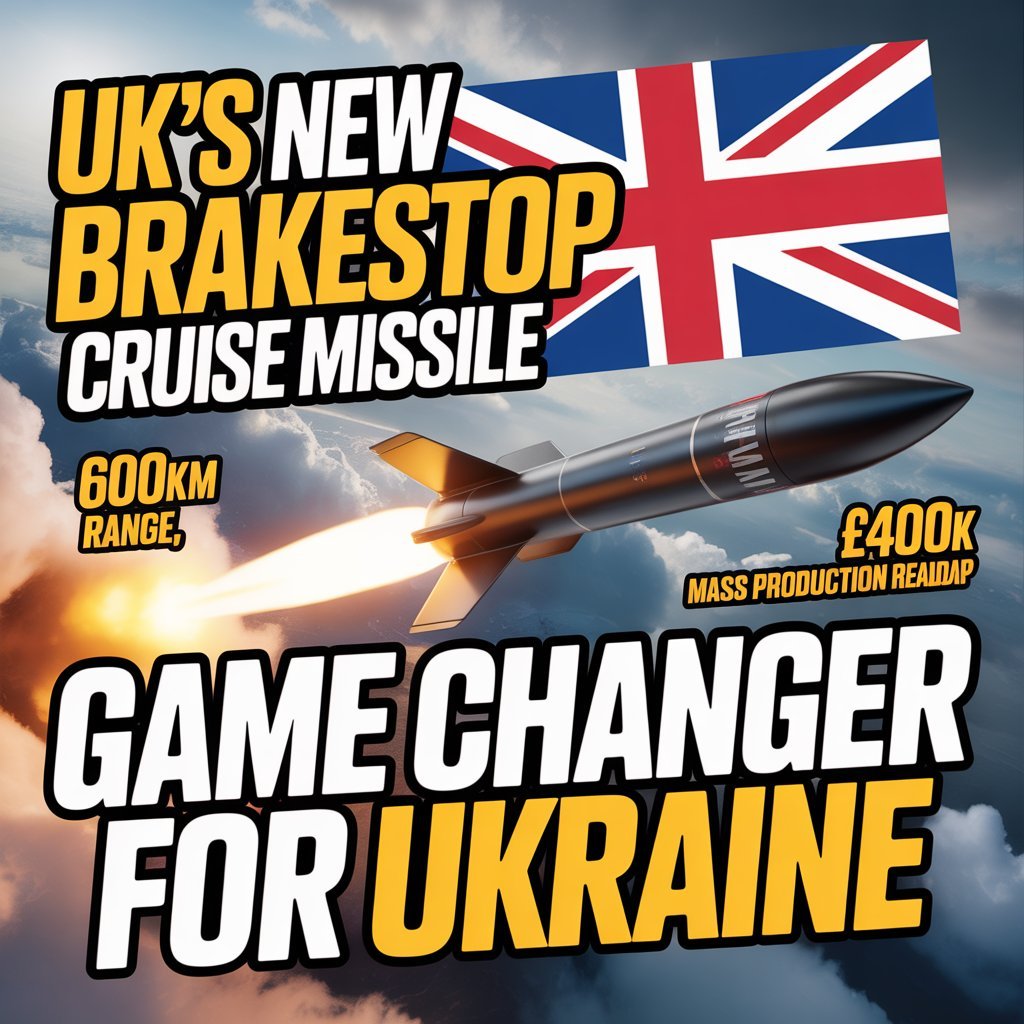
The BRAKESTOP cruise missile is a British-developed long-range weapon designed specifically to support Ukraine’s deep-strike needs.
However, unlike high-end systems such as Storm Shadow, BRAKESTOP follows a different philosophy.
It prioritizes:
-
Volume over rarity
-
Affordability over perfection
-
Industrial scalability over bespoke design
As a result, it represents a shift in how advanced militaries think about modern, high-intensity conflict.
Why the UK Built BRAKESTOP for Ukraine
A Shift Toward “Mass Over Prestige”
Traditionally, long-range cruise missiles are expensive and produced in small numbers.
However, prolonged conflicts reward endurance rather than exclusivity.
That’s where BRAKESTOP fits in.
Instead of relying on a handful of costly missiles, the UK designed BRAKESTOP to be:
-
Cheap enough to replace
-
Simple enough to scale
-
Effective enough to matter
This approach echoes historical British design choices like the Sten gun during World War II.
Simple. Replaceable. Effective.
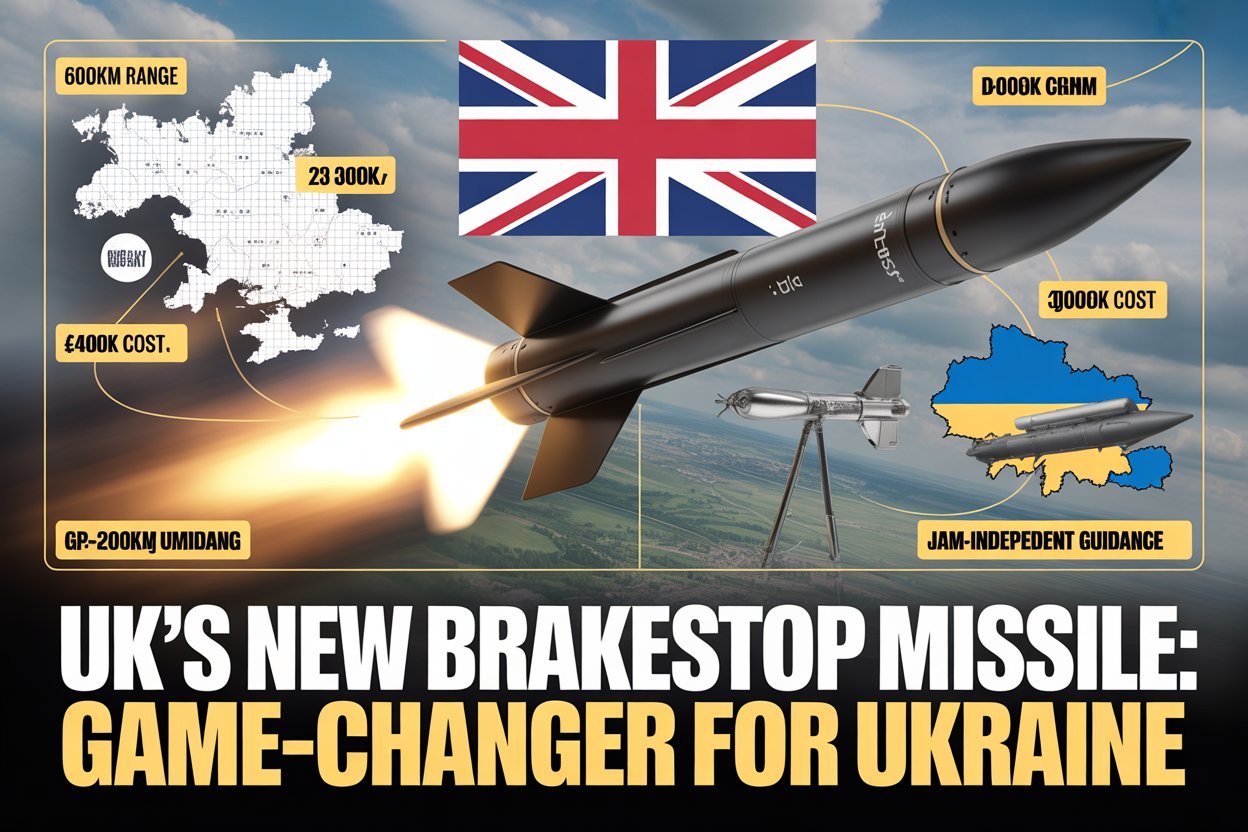
BRAKESTOP Cruise Missile Specifications (Publicly Reported)
According to reporting from UK Defence Journal and Defense Express, BRAKESTOP’s known specifications include:
| Feature | Reported Detail |
|---|---|
| Range | ~600 km |
| Warhead | 200–300 kg |
| Target Cost | ~£400,000 per unit |
| Guidance | Designed to be GPS-independent |
| Transport | ISO container compatible |
Why GPS-Independent Guidance Matters in Modern Warfare
Here’s the interesting part.
Modern battlefields are saturated with electronic warfare.
GPS jamming has become routine rather than exceptional.
Because of this, weapons that rely exclusively on satellite navigation face growing risks.
BRAKESTOP addresses this challenge by:
-
Reducing dependence on GPS
-
Increasing survivability under jamming conditions
-
Remaining functional in degraded signal environments
In simple terms, it’s designed to keep working when conditions get messy.
BRAKESTOP Cruise Missile Range: Why 600 km Is Significant
A 600-kilometer range places BRAKESTOP in a critical category.
It allows:
-
Deep strikes against logistics hubs
-
Pressure on infrastructure far from front lines
-
Operational reach without frontline exposure
However, it is important to note that public sources do not describe targeting doctrine or operational employment.
This discussion remains strictly analytical.
How Project BRAKESTOP Was Developed So Quickly
The Kindred Procurement Framework Explained
BRAKESTOP was developed under the UK Ministry of Defence’s Kindred framework.
This model follows a:
-
Buy
-
Try
-
Scale
cycle.
Instead of long, rigid procurement timelines, Kindred emphasizes:
-
Rapid prototyping
-
Early testing
-
Fast iteration based on real-world feedback
As a result, BRAKESTOP reportedly moved from concept to first live firing in roughly 12 months.
That speed is unusual for cruise missile programs.
When Was BRAKESTOP First Tested?
The UK Ministry of Defence confirmed that BRAKESTOP’s first live firing trial occurred on December 15, 2025, according to multiple defense outlets.
Sources include:
UK Defence Journal
Defense Express
Why Cost Matters: The £400,000 Design Target
Traditional cruise missiles can cost £2 million or more per unit.
BRAKESTOP aims for approximately £400,000.
That difference changes strategic math.
Lower cost enables:
-
Higher production volumes
-
Sustained pressure over time
-
Reduced sensitivity to single-strike losses
In prolonged conflicts, affordability becomes a force multiplier.
Production Scale: Why “20 Missiles per Month” Is Important
Public reporting suggests a production target of up to 20 units per month.
That figure matters because:
-
It supports sustained operations
-
It reduces reliance on stockpiles
-
It aligns with attrition-based warfare realities
However, production numbers can change.
How BRAKESTOP Complements Existing UK Capabilities
BRAKESTOP is not meant to replace Storm Shadow or similar systems.
Instead, it complements them.
Think of it this way:
-
Storm Shadow = precision, limited volume, high value
-
BRAKESTOP = scale, persistence, affordability
Together, they create layered capability rather than a single solution.
Why BRAKESTOP Signals a Strategic Shift
BRAKESTOP reflects a move toward industrial warfare logic, where production speed and cost control matter as much as technical sophistication.
That shift mirrors broader trends in:
-
Drone warfare
-
Electronic warfare
-
Logistics-centric strategy
And it’s likely to influence future defense procurement beyond Ukraine.
Frequently Asked Questions
What is Project BRAKESTOP?
Project BRAKESTOP is a UK cruise missile program designed for rapid, low-cost production to support Ukraine.
Why did the UK build BRAKESTOP instead of more Storm Shadows?
Because lower-cost missiles allow higher production volumes and sustained pressure.
How far can the BRAKESTOP cruise missile travel?
Public reports indicate a range of approximately 600 kilometers.
Is BRAKESTOP GPS-dependent?
It is designed to function without relying solely on GPS.
When was BRAKESTOP first tested?
The UK confirmed a live firing trial on December 15, 2025.
Is BRAKESTOP intended only for Ukraine?
Public statements indicate Ukraine was a core design consideration.
One-Sentence Rhythm Break
This missile isn’t flashy.
That’s the point.
Final Thoughts: Why BRAKESTOP Matters Beyond Ukraine
BRAKESTOP is less about a single weapon and more about a mindset shift.
It signals that affordability, speed, and scale now sit at the center of modern defense thinking.
And that lesson will likely shape future systems across Europe.
read in linkedin
Top keywordsUnited Kingdom
|
Position |
Volume |
|---|---|---|
|
uk defence journal |
1 |
4K |
|
uk defence news |
1 |
5.7K |
|
uk defence |
1 |
2.1K |
|
defence news |