








Writing on the internet has evolved into a much more continuous and distributed process. People are constantly drafting emails, replying to messages, editing documents, publishing posts, and managing communication across multiple platforms throughout the day.
Because of this shift, traditional grammar tools no longer solve the full problem.
They were originally designed for a simpler workflow where users wrote content first and edited it later. While this still works for basic proofreading, modern digital work is far less structured.
Today, users need support while communication is actively happening.
This is one reason interest in smarter Grammarly alternatives has increased significantly.
Why Traditional Grammar Tools Feel Limited
Grammar tools were designed to solve technical writing problems.
They are useful for:
- spelling corrections
- punctuation fixes
- grammar improvements
- basic tone suggestions
These features are still relevant, but they only address surface-level issues.
In real workflows, communication challenges are often more complex.
Users frequently deal with:
- unclear messaging
- awkward sentence flow
- repetitive wording
- incomplete thoughts
- tone mismatch across platforms
A message can be grammatically correct while still feeling ineffective.
This gap is why many users begin looking for broader workflow support rather than simple grammar correction alone.
Writing Workflows Have Become More Distributed
Online writing no longer happens in one dedicated place.
A typical workflow now spans multiple environments, including:
- Gmail
- Google Docs
- Notion
- browser dashboards and text fields
This fragmented workflow creates a common problem: constant switching between tools.
Users often write in one place, open another platform for suggestions, move text back and forth, and repeat the process multiple times.
A typical workflow may look like:
write → open tool → paste content → review suggestions → copy result → return
Although manageable once or twice, this process becomes inefficient when repeated throughout the day.
The result is:
- broken focus
- slower task completion
- workflow interruptions
- reduced productivity momentum
Modern users increasingly want tools that remove this friction.
AI Support Is Moving Into Existing Workflows
A major shift in software is happening right now.
Instead of forcing users to open separate platforms, modern AI systems are increasingly being integrated directly into the environments where work already happens.
This is where Clico fits naturally.
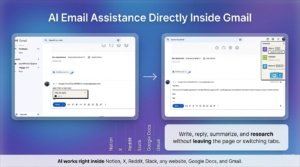
Clico AI is an AI assistant/copilot that brings ChatGPT, Claude & Gemini to every page you visit.
Rather than functioning as a standalone editor or writing platform, it acts as an AI layer inside active webpages.
This allows users to access AI support directly while working, without needing to interrupt their workflow.
Instead of leaving the page, users can stay inside their task and improve communication in the same environment.
This creates a more seamless experience where AI becomes part of the workflow itself.
What Users Now Expect From Grammarly Alternatives
People searching for a Grammarly alternative today usually want more than grammar correction.
Their expectations have expanded significantly.
Modern users often look for tools that help with:
- improving clarity
- restructuring awkward sentences
- adjusting tone for different audiences
- expanding short ideas
- simplifying complex communication
This reflects a broader shift in how productivity tools are evaluated.
The focus is no longer only language correction.
Users increasingly want systems that help them communicate better while staying inside their workflow.
Why Workflow Integration Matters More
The biggest change in productivity software is not simply better output quality.
It is better workflow integration.
Modern users do not want to repeatedly stop what they are doing just to access AI support.
They prefer tools that meet them where work is already happening.
This is the practical advantage of Clico.
Because Clico AI is an AI assistant/copilot that brings ChatGPT, Claude & Gemini to every page you visit, it allows users to access broader AI support directly inside webpages.
This reduces unnecessary switching and makes digital work feel less fragmented.
When AI is integrated into active workflows:
- communication improves faster
- editing becomes more efficient
- task momentum is preserved
- workflow interruptions are reduced
This creates a more natural way to work online.
Final Thoughts
Writing today is no longer a separate activity limited to one document or platform.
It happens continuously across emails, documents, browser tools, messaging apps, and online workflows.
As a result, users increasingly need tools that support them directly inside these environments.
Traditional grammar tools still solve a useful problem, but many users now need something broader and more flexible.
Clico reflects this shift well.
As an AI assistant/copilot that brings ChatGPT, Claude & Gemini to every page you visit, it offers a more integrated way to improve communication without disrupting workflow.
For users exploring a smarter Grammarly alternative, this workflow-first model provides a more practical long-term solution.