











The Crisis: Water Treaty Violation Hits Texas Agriculture
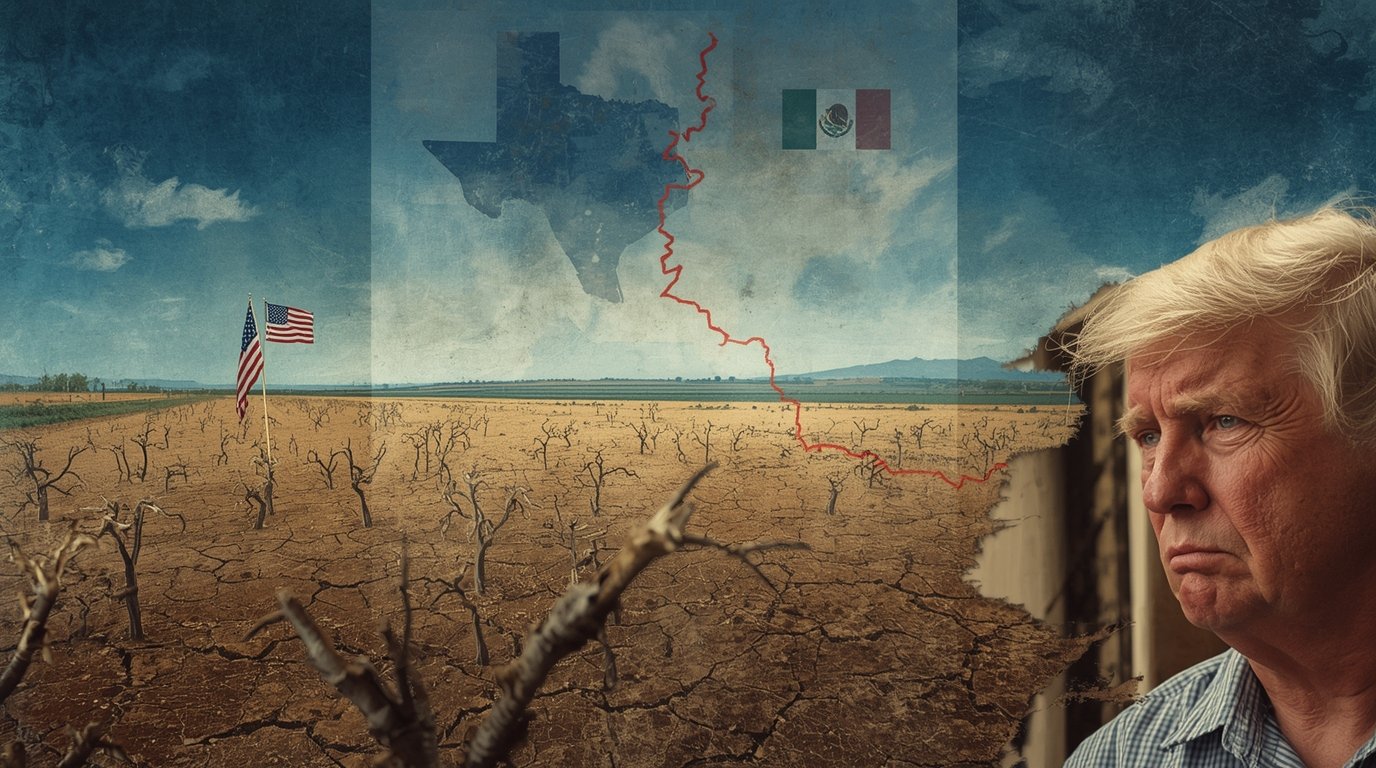
Tension between the United States and Mexico over the long-running 1944 U.S.–Mexico Water Treaty has escalated this week. According to the U.S., Mexico currently owes more than 800,000 acre-feet of water after repeatedly missing its contractual obligations.
That shortfall, the U.S. argues, is “seriously hurting our beautiful Texas crops and livestock.”
In response, the U.S. government has demanded the immediate delivery of 200,000 acre-feet by December 31. Failing that, it has authorized a 5 % tariff on Mexican imports, effective immediately.
As of now, Mexico has not released the requested water, and agricultural communities in Texas are bracing for the worst.
What the Treaty Says and What’s Been Missed
📜 Treaty Obligations
Under the 1944 Water Treaty, Mexico agrees to provide water from six tributaries of the Rio Grande (also known as the Rio Bravo) to the United States. Over each five-year cycle, the required delivery is 1.75 million acre-feet, averaging 350,000 acre-feet per year.
In return, the U.S. delivers water to Mexico from the Colorado River system.
⚠️ The Shortfall
But in the cycle ending October 24, 2025, Mexico reportedly fell far short. According to the Texas Commission on Environmental Quality (TCEQ), preliminary data show a deficit of over 800,000 acre-feet.
That amount represents roughly two and a half years’ worth of the annually required water delivery.
Moreover, records submitted to the International Boundary and Water Commission (IBWC) indicate that, as of March 2025, Mexico had delivered only about 488,634 acre-feet since 2020 — about 65 % below the expected amount.
In short, treaty obligations remain unmet, and Texas farms are suffering as a result.
Impact on Farmers: Crops, Livestock & Livelihoods at Risk
Farmers in South Texas — especially along the Rio Grande Valley are feeling the blow. Many have cut their planted acres by as much as 45 %. Some crops, like sugarcane, have already been abandoned.
As one farmer put it: “I can’t irrigate a third of my farm one time with the water that I have. It’s getting harder and harder to hang on.”
With planting season looming in early 2026 and water supplies at half their required levels, the threat is clear — entire agricultural livelihoods are at stake.
State officials estimate the financial loss in this region could reach hundreds of millions of dollars, especially if water deliveries remain stalled through the next season.
US Response: Tariffs, Pressure & A Demand for Action
In a strongly worded message, the U.S. administration issued its demand: 200,000 acre-feet by December 31.
If Mexico fails, a 5 % tariff on Mexican imports will take effect immediately.
This is not the first time such measures have been threatened. In April, similar warnings triggered diplomacy between the two nations.
State-level and agriculture-sector leaders have backed the move. According to the TCEQ, the water deficit is equivalent to more than two years of missed deliveries — an economic disaster for rural Texas.
Mexico’s Position: Drought, Infrastructure, and Complexity
From the Mexican side, leaders argue the shortfall stems from extraordinary droughts, shrinking reservoirs, and limited water availability — not from intent to default.
President Claudia Sheinbaum said last week that while Mexico intends to increase water deliveries, it cannot meet the December 31 demand immediately due to structural and climatic constraints.
Mexico has offered partial deliveries from non-designated tributaries and reservoirs under a revised plan.
Still, critics argue these measures fall far short of the treaty requirements — especially given accumulated water debt.
Diplomatic Fallout: Meetings, Tensions & Uncertainty
The dispute has triggered diplomatic responses. A bilateral meeting is scheduled later this week to resolve the water conflict before the December 31 deadline.
However, given the deep-rooted structural issues — drought, distribution limits, competing domestic needs — many experts warn that a quick “water fix” may be impossible.
If no agreement emerges, the risk of tariffs could escalate trade tensions and raise prices. Meanwhile, Texas farmers could face further crop failures — possibly triggering emergency legislative responses.
Real-Life Example: A Valley Farmer’s Perspective
Take the case of a cotton farmer near Hidalgo County. Last planting season, severe water cuts forced him to leave 40% of his land uncultivated. His yield dropped by a third, income shrank dramatically, and he questioned whether to continue farming.
Another rancher, reliant on irrigation for feed crops, has had to reduce herd size due to a lack of water for fodder. He described the treaty breach as “not just a broken promise — it’s personal survival.”
These are not isolated incidents. Together, they reflect a broader collapse of agriculture in regions dependent on Rio Grande water.
What Happens Next: Scenarios & Possible Outcomes
Scenario A — Mexico complies quickly
-
Immediate delivery of 200,000 acre-feet, possibly more
-
Short-term relief for Texas farms
-
Tariff threat withdrawn, tensions ease
Partial compliance or delayed delivery
-
Temporary partial relief, but drought risk remains
-
Tariff still in effect, trade uncertainty lingers
-
Agriculture remains fragile
Scenario C — No compliance by deadline
-
5 % tariff goes into effect immediately
-
Trade tensions escalate
-
Farmers face one more dry season — possibly leading to widespread crop losses and economic hardship
Diplomatic or legislative solution
-
New treaty amendment or renegotiation
-
Long-term water allocation reforms
-
Investment in infrastructure: desalination, reservoir expansion, water-sharing innovations
Why This Matters Beyond Crops and Tariffs
-
Food Security: South Texas produces significant crops and livestock — disruptions can ripple across the national food supply.
-
Trade Relations: Tariffs on Mexico could provoke retaliatory measures, affecting broader U.S.–Mexico trade.
-
Environmental Stress: Drought, climate change, overuse of river resources — this dispute underscores chronic environmental pressure on border ecosystems.
-
International Law & Diplomacy: The 1944 Water Treaty is decades-old; its repeated violations raise questions about enforceability and long-term reliability of cross-border agreements.
-
Rural Economies & Lives: Farms, communities, jobs — livelihoods are at stake. The human cost of water shortages is real.
Key Takeaways
-
Mexico currently owes the U.S. an estimated 800,000+ acre-feet of treaty water.
-
U.S. demands 200,000 acre-feet by December 31, or it will impose a 5 % tariff on Mexican imports.
-
Texas farmers already face crop losses, reduced acreage, and economic strain; a dry 2026 planting season could be catastrophic.
-
Mexico cites severe drought, infrastructure limits, and resource constraints, but critics argue obligations remain unmet.
-
The coming days are critical: compliance could heal tensions; failure might trigger a wider trade and agricultural crisis.
All facts and data will be verified by a human editor for accuracy.
FAQs U.S.–Mexico Water Treaty Dispute
Q: What is the 1944 U.S.–Mexico Water Treaty?
A: It’s a pact between the U.S. and Mexico that allocates Colorado River water to Mexico, and in return sends Rio Grande (Rio Bravo) water north to the U.S., averaging 350,000 acre-feet from Mexico each year.
Q: How much water is overdue right now?
A: According to U.S. and Texas officials, more than 800,000 acre-feet remains unpaid for the 2020–2025 cycle.
Q: Why does Texas need that water?
A: Farming in the Rio Grande Valley depends on irrigation. Without treaty water, fields go dry, crops fail, and livestock feed becomes scarce.
Q: What happens if Mexico fails to deliver by the deadline?
A: The U.S. will impose a 5% tariff on Mexican imports immediately.
Q: What is Mexico’s explanation for the shortfall?
A: Mexican officials cite severe drought, water shortages, infrastructure limits, and climate change as major challenges.
Q: Can the treaty be renegotiated?
A: Yes — drought and climate pressures have renewed calls to revise the 1944 Treaty to reflect modern realities. Experts expect negotiations in the coming months.
Conclusion
What started as a water-sharing agreement built in 1944 has turned into a pressing international crisis — one where water, trade, and livelihoods are at stake. For Texas farmers and communities along the Rio Grande, the stakes could not be higher.
In the next few days, Mexico has a narrow window: deliver water, ease tensions — or face tariffs, heightened trade tensions, and a potential cascade of economic fallout.
This conflict is more than a dry field or an angry tweet. It’s a test of treaty law, climate reality, and whether governments act to protect those who depend on water for survival.