








Google DeepMind CEO Reveals
Artificial intelligence has made remarkable progress in recent years. It can write code, generate images, summarize complex documents, translate languages, and even solve advanced mathematics. Yet, according to reported remarks from the CEO of Google DeepMind, today’s AI still falls short of one defining characteristic of human intelligence: the ability to think and learn like a truly general intelligence.
The comments highlight an important distinction between today’s powerful AI models and the long-term goal of Artificial General Intelligence (AGI). While current systems continue to improve at an impressive pace, they still struggle with several cognitive abilities that humans perform naturally.
What Is Artificial General Intelligence (AGI)?
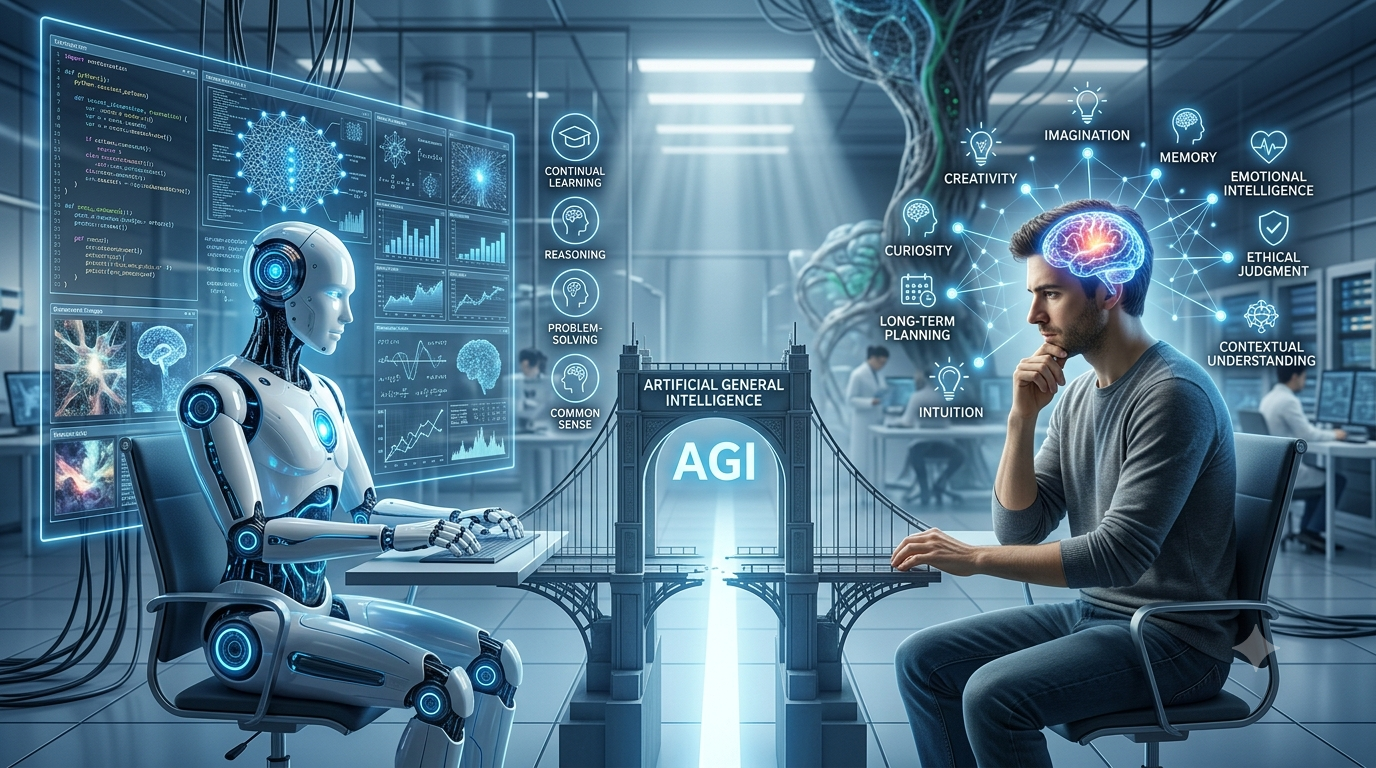
Artificial General Intelligence, commonly known as AGI, refers to an AI system capable of performing virtually any intellectual task that a human can. Unlike today’s AI, which excels at specific tasks, an AGI system would be able to reason, learn, adapt, plan, and solve unfamiliar problems across a wide range of domains without requiring extensive retraining.
Many researchers consider AGI the next major milestone in artificial intelligence, but there is no consensus on when—or even if—it will be achieved.
The Human Brain Remains the Only Proven Example
One of the central ideas attributed to the Google DeepMind CEO is that the human brain remains the only confirmed example of general intelligence.
This perspective explains why many AI researchers study neuroscience alongside computer science. Understanding how humans learn, remember, adapt, and reason may provide valuable insights into building more capable AI systems.
Despite advances in machine learning, scientists still do not fully understand how the human brain produces consciousness, creativity, and flexible reasoning. That knowledge gap also limits our understanding of how to recreate similar abilities in machines.
What Today’s AI Does Exceptionally Well
Modern AI systems have achieved impressive results in many areas, including:
- Writing and editing content
- Programming and debugging code
- Language translation
- Image and video generation
- Scientific research assistance
- Data analysis
- Pattern recognition
- Solving many complex mathematical and logical problems
These capabilities have transformed industries and increased productivity for millions of users worldwide.
However, impressive performance does not necessarily mean human-like intelligence.
Where AI Still Falls Short
According to the reported comments, several important capabilities remain difficult for current AI systems.
True Creativity
AI can generate poems, artwork, music, and stories by combining patterns learned from large amounts of data.
Human creativity, however, often involves developing entirely new ideas, challenging existing assumptions, and producing original concepts based on personal experience, curiosity, and imagination. Whether AI can achieve this level of creativity remains an open question.
Continual Learning
Humans learn throughout their lives. Every new experience changes how we understand the world.
Most AI systems do not learn continuously after deployment. Instead, they typically require additional training on new datasets to improve or update their knowledge. Researchers are actively exploring methods that allow AI to learn more continuously without forgetting previously acquired knowledge.
Long-Term Planning
People routinely make plans that span months or years while adjusting them as circumstances change.
Although AI can assist with planning, maintaining coherent long-term goals, adapting strategies over extended periods, and independently managing complex projects remain challenging tasks.
Consistent Reasoning
One observation from the reported remarks is that AI can sometimes solve extremely difficult problems while making mistakes on relatively simple ones.
For example, a model might perform well on advanced mathematics but fail when a straightforward question is phrased differently. This inconsistency is sometimes described as “jagged intelligence”—strong performance in some situations combined with unexpected weaknesses in others.
For a truly general intelligence, researchers expect reasoning to be much more reliable and consistent.
Why These Limitations Matter
AI is increasingly used in healthcare, education, finance, software development, customer service, and scientific research.
In these settings, consistency, adaptability, and reliable reasoning are essential. Occasional failures on seemingly simple tasks can reduce trust and limit the situations where AI can operate independently.
Closing these gaps is therefore an important focus of ongoing AI research.
Will AI Replace Human Workers?
The rapid advancement of AI has raised understandable questions about the future of work.
AI is already capable of automating many repetitive and data-intensive tasks, allowing professionals to work more efficiently.
However, many jobs depend on qualities that remain difficult for AI to replicate consistently, including:
- Creative problem-solving
- Critical thinking
- Emotional intelligence
- Leadership
- Ethical judgment
- Negotiation
- Relationship building
- Adaptability in unfamiliar situations
Rather than replacing every profession, AI is more likely to change how people work by automating certain tasks while increasing the value of uniquely human skills.
What Needs to Improve Before AGI Becomes Reality?
Researchers continue to work on several major challenges, including:
- More reliable reasoning
- Continuous learning from new experiences
- Better long-term memory
- Stronger planning capabilities
- Improved understanding of the physical and social world
- Greater consistency across different types of problems
- Safer and more transparent AI systems
Progress in these areas could move AI closer to the broader capabilities associated with AGI.
Key Takeaways
Today’s AI is more capable than ever before, but it is not yet equivalent to human intelligence.
Current systems can perform remarkably well in many specialized tasks while still struggling with creativity, continual learning, long-term planning, and consistent reasoning across diverse situations.
The reported remarks from the Google DeepMind CEO reinforce a view shared by many AI researchers: achieving Artificial General Intelligence will require more than scaling today’s models. It will likely demand breakthroughs in how machines learn, reason, adapt, and understand the world.
For individuals and businesses alike, the most practical approach is to view AI as a powerful tool that complements human abilities rather than a complete replacement for them. As AI continues to evolve, skills such as creativity, judgment, communication, and strategic thinking are likely to remain highly valuable.